Ranking Member Andrea Salinas Grills U.S. Forest Service Chief Over Reorganization as Wildfire Season Rages
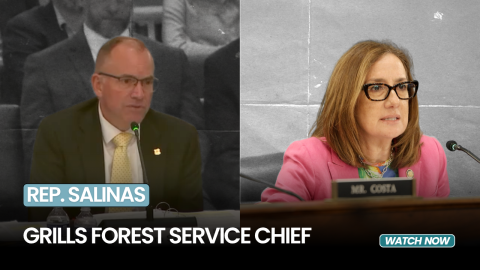
Click here to watch Rep. Salinas’ full opening remarks.
WASHINGTON, D.C. — Today,Ranking Member Andrea Salinas (OR-06) of the House Agriculture Subcommittee on Forestry and Horticulture pressed U.S. Forest Service Chief Tom Schultz. pressed Tom Schultz, U.S. Forest Service Chief. She questioned him about President Trump's plans to reorganize the Forest Service, which will take workers off the ground, threaten public lands, and make forests and communities more susceptible to deadly wildfires.
A transcript of her opening remarks can be found below.
Rep. Salinas: Thank you, Chairman Newhouse, for convening us today, and thank you to Chief Tom Schultz for joining this Subcommittee hearing so we can better understand the work and capacity of the Forest Service and what it needs to successfully deliver for the American people.
Before we begin, I want to acknowledge the two Forest Service employees who were recently taken hostage while serving the public in California’s Shasta-Trinity National Forest. We are grateful for their safe return, and our thoughts remain with them, their families and all public servants who face risks in the line of duty.
Scientists predicted that 2026 would be a difficult fire year, and they were right. More than 3.9 million acres have already burned nationwide, that’s 900,000 more acres than the 10-year average! With these blazes, we saw the tragic loss of three firefighters on the Cottonwood Fire along the Colorado-Utah border, and a Canadian helicopter pilot on the Gold Mountain Fire. Our hearts go out to their families and their crewmembers, including the two additional firefighters who were injured. These statistics highlight how severe the wildfire danger has become and the need to ensure our public land management agencies are working at full capacity.
Unfortunately, the Trump administration has been focused on topics other than wildfire preparedness: from its disruptive, and likely illegal reorganization plan and the consolidation of wildfire response under the Department of Interior, to a myopic focus on commercial timber harvest at the expense of hazardous fuels treatments – all of which are making our communities less safe.
I frequently hear from Oregonians and stakeholders that this Administration is causing chaos on our public lands. Current employees of the Forest Service are demoralized and confused about what the future holds. The agency has lost 16 percent of its staff since 2024, and I have heard that some employees do not know who they report to anymore. The agency also sent 6,500 of the remaining employees a vague letter in March that their jobs would be affected by the reorganization, but four months later there are still no details, only anxiety and uncertainty for these workers and their families.
It’s difficult to see the chaos as anything other than intentional. Despite overwhelming negative feedback from the public, employees and former senior Forest Service officials, the administration has carried on with its plan. And we know now, despite past statements by the administration, that they did have a goal to push out our Forest Service employees. They prepared their plan behind closed doors, with a goal to push out 15 percent of the Forest Service staff. And, no surprise, they hit that target. The public and Congress are now saddled with the consequences.
It continues to feel like the administration is hiding critical information about the reorganization at every turn. 500 employees originally received notices that they may have to relocate, specifically employees in Washington, D.C., Milwaukee, Atlanta and Portland. However, agency whistleblowers highlighted in a letter to the committee that this number is not consistent with the number of employees working in buildings identified for closure under the reorganization plan. Mr. Chairman, I ask unanimous consent to enter that letter into the record.
This sweeping reorganization creates more questions than answers, and the fact that it’s being implemented right as wildfire season is upon us is alarming. Doing so threatens the Forest Service overall – the loss of staff, and the institutional knowledge they have, should not be casualties in the Trump administration’s reorganization of the Forest Service. Each is too valuable to be lost.
This brings me to another action by this administration that is causing serious concern – the attempt to consolidate wildfire management into the Wildland Fire Service under the Department of Interior. This consolidation of wildfire response would strip staff from the Forest Service to work for the new agency. But these employees not only fight wildfires at the Forest Service, they also engage in important forest management that mitigates future wildfire risk. This proposal would fracture the critical communications link between land management and fire management and it is yet another threat to the Forest Service’s efficacy.
Given how much disruption the Forest Service has endured, it is no surprise that many of its key performance metrics have suffered. From 2024 to 2025, the Forest Service treated roughly 25 percent fewer acres for hazardous fuels, and it is on track to hit that same weak target again this year. It also published less research, issued fewer recreation permits, and completed fewer miles of trail maintenance. This is not efficiency. At some point, the fewer people on the ground to do the work, the less work gets done.
Chief, you have a lot of experience in forestry, and my guess is that you’ve probably stopped some even worse things from happening under this Administration. At the end of the day, though, we simply can’t be satisfied with avoiding the worst outcomes. We have got to do better.
Thank you, Mr. Chairman, and I yield back.
Click here to watch Rep. Salinas’ full first line of questions.
A transcript of her question line can be found below.
Rep. Salinas: Thank you, Chairman Newhouse, and thank you, Chief Schultz, for your testimony. This year's wildfire season is already demonstrating the dangerous and increasingly year-round nature of wildfire risk, threatening communities, public health, and natural resources across our country. The Department of Agriculture and Forest Service play a crucial role in preventing and combating wildfires. So, in carrying out a sweeping reorganization of USDA and the Forest Service, it's important to look at the data and seek public input for guidance. As part of that review process, USDA sought public comment about this reorganization with the purpose of hearing from the public and your own employees about your plans. Do you know how many responses the agency received?
Chief Schultz: I do not know. No, ma'am.
Salinas: Okay. Well, USDA received over 14,000 public comments about the reorganization. 27% of general comments were specifically about the Forest Service. Do you know what percentage of comments provided positive feedback and what percentage provided negative feedback?
Schultz: No, ma'am. I don't know.
Salinas: All right. Well, 82% expressed negative sentiment. The reorganization proposal received less than 20% positive feedback. Tribal representatives, conservation groups, and even former Forest Service staff opposed the move, and they, and the key themes in the feedback related to safeguarding the Forest Service mission: loss of local oversight and expertise, reductions in personnel and resources, and transparency in the reorganization process. Stakeholders overwhelmingly rejected this plan, and it was folks with some expertise. Another important factor for reorganization is how it will affect staffing levels. Chief Schultz, you testified at the Senate Agriculture Committee that you did not think that staff subject to relocation would likely leave. You said, and I'm quoting from your testimony, "we do not anticipate overall that it is going to be a significant number of people," but your testimony directly contradicted by what the department said in its internal, previously confidential reorganization plan that recently became public. The reorganization plan said, and I quote, "a significant number of employees will decline geographic reassignments." These are previously undisclosed documents directly from USDA officials. Recent history and surveys back up what the USDA's own report said about this reorganization. In 2019, the relocation of the Economic Research Service and National Institutes of Food and Agriculture from Washington, D.C. to Kansas City, Missouri, resulted in about 85% of employees either quitting or retiring instead of actually relocating. The relocation of BLM headquarters in 2019 caused 87% of the affected employees to leave, and just this year, 76% of USDA employees surveyed by the American Federation of Government Employees said they would not relocate if asked. Given all this evidence, it seems clear that requiring staff to relocate results in staff leaving and the loss of critical expertise and institutional knowledge. So, Chief, you are on the record, and I want to give you an opportunity to revise your prior testimony. Do you now admit that, based on recent history, survey data, and internal documentation, the reorganization plan will likely result in a significant number of employees declining geographic reassignment?
Schultz: Ms. Salinas, I do not change my statement previously. What I would tell you is that right now we're looking at less than 500 employees that we would anticipate having to relocate across the agency. Most of those would be in the Washington office. For instance, in Oregon right now, we talked about relocating folks from the office downtown, and we have basically told them within their current commuting area, the Oregon staff in Portland would have an opportunity to locate without having to relocate their homes, but they could drive to the locations in the future. So no, we expect less than 500 people across 30,000 employees to actually have to physically relocate. Of that 500, I don't have a good sense whether that's going to be 50% or 80%, as you alluded to some prior statistics. But overall, we have worked with employees extensively. We're currently surveying our employees about where the ones that would have to relocate, where they would like to go, in terms of the job. They're having input into that process. It's been an extremely thoughtful process. It's not necessarily evident externally. We have town hall meetings every two weeks to work with our employees to communicate with them. We are sitting down with those employees to identify options for them in jobs. So, I do not change my prior statement. I think overall. We are not going to have significant losses of employees through this process. In most cases, people are going to be able to continue to work from locations where they're at. We talked about those three offices in Atlanta, we talked about Minneapolis, and we talked about Portland. And in Portland, like I just said, we think we're going to have opportunities for most, if not all, of those employees to be able to stay where they live and commute within that commuting area, so I don't change my statement.
Salinas: Well, I look forward to that reorganization working out for the work.
Click here to watch Rep. Salinas’ full second line of questions.
A transcript of her question line can be found below.
Rep. Salinas: Chief Schultz, this reorganization will cost taxpayers money. Under the first Trump Administration, taxpayers paid an estimated $28 million to cover the cost of the 2019 reorganization of the Bureau of Land Management. And after that move failed, the Biden Administration was forced to bring many positions back to D.C. How much is the Trump Administration requesting from the taxpayers for the overall reorganization of USDA,
Chief Schultz: Mr. Chairman, Ms. Salinas, we have no specific line item that we're asking for to facilitate the reorganization.
Salinas: Okay, as I understand it, your budget calls for $55 million for reorganization, while at the same time you are slashing Forest Service research down to zero. I think what I'm getting at, though, really is, you know, you told us you were in a budget deficit and you were trying to do more with less. Why don't you try to do more with more? Why is the Administration not asking for the amount that it actually needs to help us with the land management that I think we're all asking for and prevent these wildfires in the first place?
Schultz: Right, Mr. Chairman, Ms. Salinas. I think what we're looking at overall is how do we run government in a way that provides the services to the public, the American public that they want, in a way that we can sustainably manage that long term with the appropriate amount of funding. I think there's always going to be debates about how much funding is necessary. One of the things we're trying to look at it's not just a dollars and cents. It's also looking at the processes that we have. So a big part of what we're looking at is the deregulatory environment. The Forest Service has created 3,600 directives. That's above the statutes, that's above regulations that have been either promulgated by Congress or adopted by the agency. So we think that by reducing a lot of the red tape that we have created internally, will actually make things cheaper and easier to get done long term. So it's not always a fact that we need more money. In many cases, it's the regulatory processes that we've put in place, for whatever purpose that we've done that, that we think we can reduce that and reduce the funding that's needed. So that's part of what's driving what we're doing as well. But in terms of necessary funding to run the agency, we are proceeding with the reorganization. We think it's going to save money long term, and I'll just give a real quick example: the Yates Building, which is the building that we occupy here in D.C. That lease, on an annual basis, we spend close to nine and a half million dollars a year for that building, and part of that is the security for that building. The Forest Service occupies probably about 30 to 40 percent of that building at most. We anticipate moving into one floor, so the Forest Service cost in that building will be reduced by about 75 percent, down to less than $2 million a year, so when we look at that overall cost structure, just the Yates building alone will save us $6 million a year. So over 10 years, that's $60 million, and then we look at those the other leases that we've got, whether it's the lease in Portland or Milwaukee or Atlanta, those are high expensive buildings. We know we're never, we've never had enough money for all the facilities. This is not a new issue, whether it's the leased facilities or the owned facilities. So what we're trying to do is take a very thoughtful approach about where can we consolidate facilities and buildings. We want to retain the work that we're doing. We've had a lot of discussion about closures. We're not talking about closing programs. We're talking about facilities that we can co-locate, that we can utilize, whether it's other agencies, like we're going to have like in Oregon, for instance, the new state office is going to co-locate with the Oregon Department of Forestry. We're going to be co-located with the state agency. We think that's a good fit for the state. I think it's a good fit for the Forest Service, and it's going to be a cheaper overall structure than maintaining the buildings that we have. So we're trying to take a broad-based approach to reduce our costs, but maintain the programs that we deliver to the public.
Salinas: But there will be programs that are going to be closing. We already know that you're, you know putting the Forest Service research down to zero. So there will be programs within the Forest Service that are needed. That expertise is needed, and we will not be seeing that work get done. And so I, you know, with overwhelming negative feedback on the reorganization plan from the public, you'll lose hundreds of valuable staff. This reorganization is going to cost taxpayers millions of dollars. We've already seen about what $338 million dollars in the deferred resignation program. So all of these little pieces have, we've already spent. The taxpayers have already spent $338 million to get rid of good people, hardworking people with the expertise that we need. So I am feeling very frustrated because I've heard, you know, Mr. Costa, I think Mr. Carbajal, we've all asked for analysis, and it sounds like you have that analysis, but you're not sharing it with us as you're moving along, so I I'd like to continue this conversation after this hearing and maybe and just get some additional feedback on a more regular basis. But thank you so much for your testimony. Thank you for being here. I yield back.